
Employers operating multilingual workforces with chemical hazards face a critical blind spot: Language barriers drive workplace injuries, regulatory violations, and liability exposure. When workers don’t understand safety instructions and labels, training, and emergency protocols are inaccessible in their primary language, miscommunication becomes a hazard itself.
Many workplace injuries stem from inadequate training for non-English speakers. Beyond the human cost, there’s regulatory penalty, litigation, and reputational damage. As Online SDS, a provider of integrated workplace safety and chemical management solutions, explains below, closing the language gap in chemical safety isn’t optional compliance; it’s liability prevention.
How Language Barriers Drive 66% of Workplace Injuries
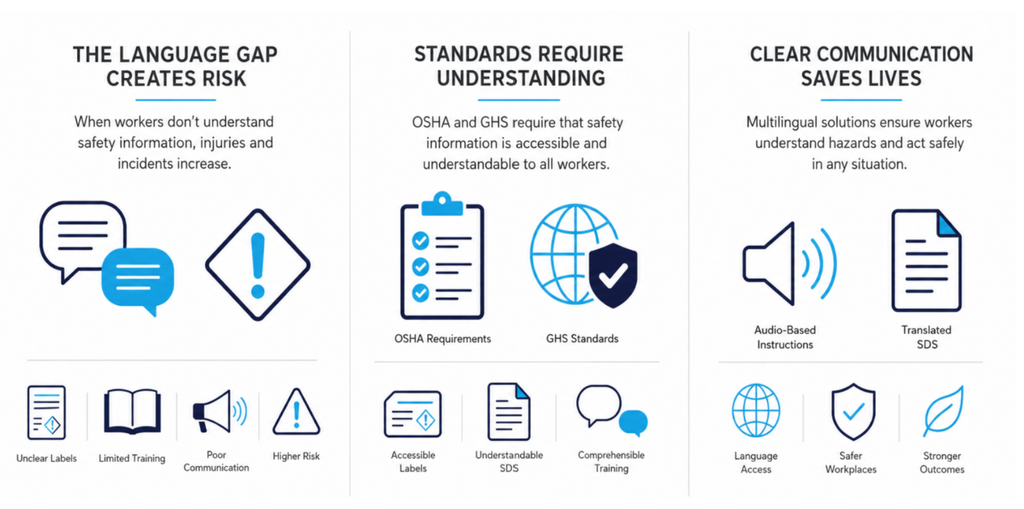
Workers whose first language is not English are at greater risk than those who speak it natively. They require specialized safety training and instructional materials that convey the risks and best practices of hazard-facing roles in terms they can fully understand. A study attributed 66% of workplace injuries specifically to inadequate training and resources for non-English speakers.
Moreover, data from the Census Bureau shows that while English is spoken at a high level by 78.3% of the population, among those who do not speak it in their home environment, there’s a much larger comprehension gap. With 53.3 million foreign-born people living and working nationally, the reported 60.9% proficiency level in English shows that there’s a need to adapt workplace safety practices to accommodate those who are still getting to grips with the nation’s most widely spoken language.
Why OSHA and GHS Standards Demand Multilingual Compliance
OSHA’s Hazard Communication Standard and associated guidelines clearly define the expectations employers must meet regarding potentially dangerous chemicals. Most importantly, employers must ensure that labels and Safety Data Sheets (SDSs) are readily accessible to employees during each work shift. OSHA explicitly requires training to be presented in a language and vocabulary that workers understand.
The Globally Harmonized System (GHS)—a UN mandate—standardizes chemical labeling through pictograms, signal words, and a 16-section SDS format. While pictograms are standardized, the dense technical prose in SDS Sections 4 to 8, which cover first aid, firefighting, accidental release, and exposure controls, relies on linguistic fluency to execute safely.
There are stringent legal requirements for chemical hazard management that businesses must follow in order to meet national and international standards. Falling short runs the risk not only of serious incidents but also of regulatory punishment, damaging brand reputation, legal action taken by affected parties, and the disintegration of commercial partnerships.
Audio-Based Training and Translated SDSs Can Reduce Injury Risk
Translation matters. Employers must ensure training and SDS labels are accessible in workers’ primary languages. However, text-based warnings and hazard-related processes, such as post-spill instructions, have limits, even with robust translation applied.
The problem stems from how our brains process information, especially in stressful situations. Having to read text from a label or screen and respond appropriately is hard enough if it’s in your native tongue, let alone if it’s in a second or third language.
That’s why audio-based SDS access tools can be helpful for many operations. Audio-assisted instruction activates the auditory processing channel rather than overloading the visual channel in our attention hierarchy, which is occupied by the physical spill or victim, enabling faster task completion. Moreover, audio-based SDS tools leave workers with their hands free to make interventions as needed, rather than being encumbered by paper documents or screen-embedded devices.
The cognitive load of processing safety information in a non-native language compounds the pressure of emergencies. In a chemical spill, a worker has seconds to act—not minutes to parse dense technical text. Studies on multilingual cognition show that under stress, non-native speakers revert to their primary language for rapid decision-making. Audio-based systems bypass this bottleneck entirely. A worker hears instructions in their native language, processes them faster, and responds without the delay of translation or text comprehension. This speed difference can mean the gap between containment and escalation, between a managed incident and a full-scale accident.
Closing the language gap in chemical safety is critical. Employers face injury lawsuits, OSHA penalties, and damaged partnerships when workers misunderstand hazard information. Combined with multilingual training, tools like translated SDSs and audio-enabled platforms can help cut through the miscommunication that drives injuries.